Sunday, June 16, 2013

The Plestcher Double Kickstand Bolt

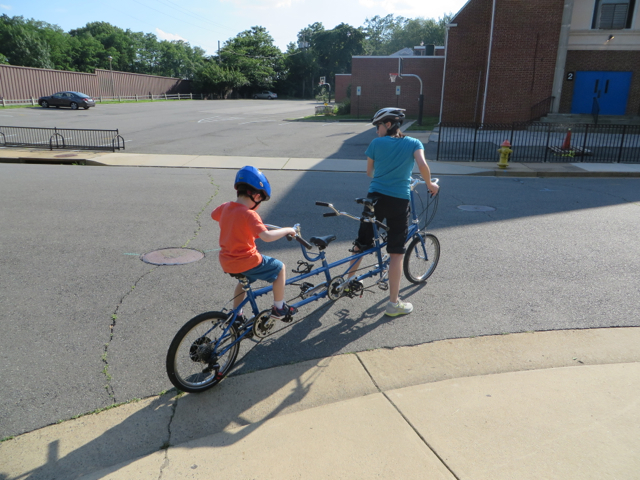
We recently picked up a used Bike Friday Triple Tandem to ride with the kids.

The Boss with our boy.
As one might guess, it's huge and heavy.  The old owner smartly picked up a Pletscher Double Kickstand for the bike but decided to use the clamp instead of the kickstand plate.

Naturally, this lead to what size and length of a bolt do I need?  A quick search didn't result in any satisfying hits so after a few measurements and quick trip to an auto part store, I picked up ...

The shortest M10x1.5mm screw at the store
I was relatively confident that it would be too long but just to check ...

That is about 5 mm

... so I picked up a few washers.  If you're looking for a short screw for a Pletscher Double Kickstand for a kickstand plate, I'd get a M10x1.5x16mm screw.

Friday, May 31, 2013

How to remove a "stuck" cleat

It's common knowledge that one should occasionally check the screws that attach the cleat to a cycling shoe.  However ...
It is human nature to think wisely and act in an absurd fashion.
... which led me to this.

Truth-seeker discovers his own humanity.  Notice that
access to the remaining screw and cleat is limited by the pedal.  
What happened here is after ignoring the cleat for well over a year, one of the screws came loose and fell out during a ride.  With only one screw holding the cleat, as the shoe twists the cleat stays locked inside the pedal.

After removing the insole, one can see that a second
screw is missing in the hole on the right. 
You might notice in the first picture that there is too little space to fit another screw and screw driver.  Once you remove the insole, the solution is obvious.  Stick a screw into the right hole ...
Screw partially inserted.
... and twist the shoe off the pedal.
Woo hoo!
Obviously, I had a sandal here which made inserting a screw into the loose cleat a simple task.  Different shoes could limit access making the process more difficult.

Tuesday, May 28, 2013

To segregate or not

In a series of posts regarding Bike to Work Day, Jan Heine first lamented the indiscriminate application of segregated bicycle facilities and followed by a summary that includes points made in the comments.  For those unfamiliar, Jan is explaining the vehicular cycling position based on traditional traffic engineering principles and largely describes my perspective on bicycle facilities.  While there is a lot to discuss, here I focus on two observations during these deliberations.

The first point is that with respect to risk, "bicycle drivers" -- those that ride their bike according to the traffic principles for all vehicles -- tend to look at the marginal effect of a facility whereas "facilitators" focus on the "total" effect.  The total effect here is the direct effect of the facility on risk plus a safety-in-numbers effect or Smead's Law.  There are two things that I consider pretty obvious.  One, building on the argument Jan present and considering the literature on cognitive and visual awareness the effect on the margin increases risk to the cyclist.  Two, there is a broad and strong correlation between more cyclists and lower risk.

The safety-in-numbers effect deserves more attention.  There appears to be no scientific agreement regarding the underlying causality of safety-in-numbers.  The linked authors discuss several mechanisms by which safety-in-numbers could be causal versus a spurious effect.  Writing specifically with respect to cycling we can imagine that greater numbers of cyclists are simply more visible or result in changes in driver behavior.  Alternatively, greater numbers of cyclists could result in slower motor vehicle traffic which results lower risk.  Given the segregated facility question, the facility might attract more risk-adverse cyclists, dissuade drivers from using the street, slow down drivers, or slow down cyclists resulting in lower risk.  Of course, these are just a few examples since one can imagine lots of reasonable mechanisms that result in the observed correlation.  In the end, my take is that segregated cycling facilities should be used with caution to connect comfortable transportation grids with a "residential" pace.  (Jan's conclusion.)

The second point is that many of these conversations end up being dominated by people speaking past each other in part due to people assuming the worst from "the other side".  That is, bicycle drivers often assume that facilitators are willing to accept any cycling specific facility regardless of design or environment while facilitators assume that bicycle drivers reject any cycling specific facility.  For what it's worth, I broadly find that there is a lot agreement even if the final conclusion is different.  With the years of heated debate, it will be difficult to move people with a single conversation.  But the first step is to start more civilized discussions without the polemics.

Wednesday, July 11, 2012

A quick blip on riding in the normal traffic lane

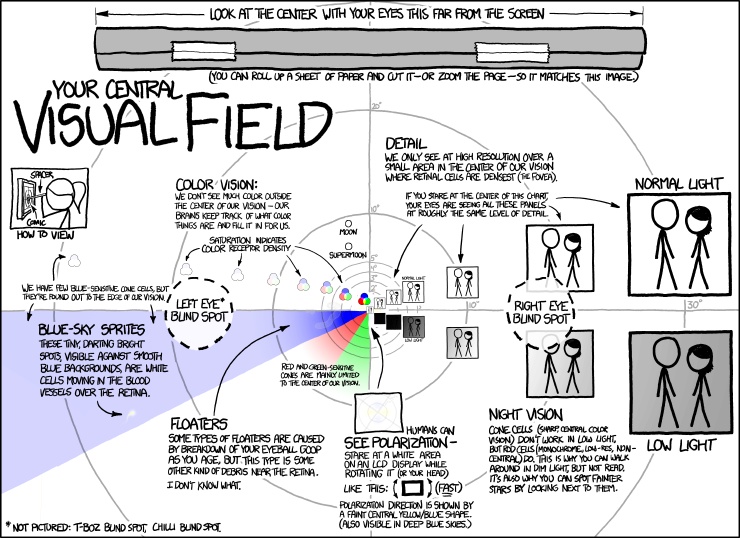
The always interesting XKCD comic did an graphic on a person's visual field.  It immediately reminded me of a fundamental reason why safe cycling experts strongly suggest riding in the primary focus points of a driver ... the center of the lane.

Experiment with the graphic below to see how much less detail and color we see outside a narrow band of the focus point.  Riding to the far right often puts the cyclist in a location where they are less likely to be cognitively recognized and actively accounted for by the driver.


Sunday, July 8, 2012

Let's stop perverse motives in prison sentencing

It is commonly understood that perverse things happen in prisons but we should to be outraged when justice is twisted to further personal interests at the expense of the incarcerated but to their families, loved ones, and the greater society that needs these precious resources.  Consider the following two examples.

Louisiana has become the state with the highest rate of incarceration in the US.  Fundamentally, this is driven by "entrepreneurial" prisons owned by rural sheriffs and law enforcement receiving funds connected with prisons and the number of prisoners incarcerated in them.
If the inmate count dips, sheriffs bleed money. Their constituents lose jobs. The prison lobby ensures this does not happen by thwarting nearly every reform that could result in fewer people behind bars.
Not only are sentences shockingly high -- "a two-time car burglar can get 24 years without parole" -- but the likelihood of parole has dropped since Louisiana has shifted to the paradigm of entrepreneurial prisons.  See a full-sized version of the graphic with this link.


Except from the Times-Picayune graphic


The California Correctional Peace Officers Association -- the union for its prison guards -- is infamously influential in state politics and has pushed a pro-incarceration agenda for years. 
It gave over $100,000 to California’s Three Strikes initiative, Proposition 184in 1994, making it the second-largest contributor. It gave at least $75,000 to the opponents of Proposition 36, the 2000 initiative that replaced incarceration with substance abuse treatment for certain nonviolent offenders. From 1998 to 2000 it gave over $120,000 to crime victims’ groups, who present a more sympathetic face to the public in their pro-incarceration advocacy. It spent over $1 million to help defeat Proposition 66, the 2004 initiative that would have limited the crimes that triggered a life sentence under the Three Strikes law. And in 2005, it killed Gov. Schwarzenegger’s plan to “reduce the prison population by as much as 20,000, mainly through a program that diverted parole violators into rehabilitation efforts: drug programs, halfway houses and home detention.”
Why push the agenda?  CCPOA member Lt. Peters explains in the context of pushing the Three Strikes law.

You can get a job anywhere. This is a career. And with the upward mobility and rapid expansion of the department, there are opportunities for the people who are [already] correction staff, and opportunities for the general public to become correctional officers. We’ve gone from 12 institutions to 28 in 12 years, and with “Three Strikes” and the overcrowding we’re going to experience with that, we’re going to need to build at least three prisons a year for the next five years. Each one of those institutions will take approximately 1,000 employees.
Moreover, the political power wielded by the union also shelters its members from oversight and prosecution.

If for some reason fair play and justice for the incarcerated fail to get one riled, then there are several practical reasons to stop allowing self-motivated agents push for extraordinarily long sentences.  One, keeping people in prison is really... really ... really expensive.  By an estimate, a year in state prison costs more than a year at Princeton.  Mind you, this only captures the accounting costs of keeping that man or woman in prison in that a person in prison is broadly not a productive member of society.  Moreover, skills deteriorate in prison reducing a former inmates ability to be productive.  Two, if we treat non-violent offenses severely, the consequences of being caught for violent and non-violent crimes becomes relatively more similar and there is less incentive for a criminal to avoid violence.  In other words, if someone is going to say rob a store or a person, one might as well use a deadly weapon since the difference in punishment might be small.  Three, decades of research strongly suggests that increasing the likelihood of being caught and punished is a better crime deterrent than the severity of punishment.  Take for example, Honolulu's project HOPE as described here.  In short, not only are we using a lot of resources that we desperately need elsewhere -- 10.4 billion dollars by Pew's back of the envelope calculation -- we're getting lousy results with high recidivism!

We can be tough on crime, but we should be smarter on who we lower the hammer.  At the moment, we have over six million of people in prison at a higher rate per population than any other country in the world.  Moving to a strategy of greater certainty and swifter punishment rather than long sentences sounds like a really complicated and perhaps expensive strategy.  Although there are some working examples of how to move forward on the idea.  But we can continue what a handful of states have already started with the obvious step of using our dollars more wisely by tailoring our sentences to keep violent and threatening criminals off the street rather than those committing crimes which might annoy, offend, or make life a more difficult in the short run.  It's something that liberals and conservatives can support together.

Wednesday, June 20, 2012

Capital Bikeshare: an earmark for rich white people?

Reason magazine -- associated with the Cato Institute -- recently declared Capital Bikeshare a subsidy for rich white folks.
Capital Bikeshare, which rents bikes at more than 165 outdoor stations in the Washington D.C. area, serves highly educated and affluent whites.
There's nothing wrong with that, of course, except that the program has received $16 million in government subsidies, including over $1 million specifically earmarked to "address the unique transportation challenges faced by welfare recipients and low-income persons seeking to obtain and maintain employment."
I'm no expert on Capital Bikeshare, but just based on a few perused articles I've read in the past and the Reason video, it's reasonable to conclude that the direct-effect of bike sharing has done little for DC area poor.  If one is going to evaluate it on that basis alone then indeed, it's a boondoggle.

But if we're going to ask ourselves ...
Why are affluent, educated, and employed whites riding taxpayer-subsidized bikes?
... in the greater context of whether a transportation subsidy is worthwhile, then it seems appropriate to evaluate it in the context of other subsidized transportation which would include driving, public transportation, and just about anything that comes to mind.  For instance, consider the subsidy to driving ...
Economists have long criticized the current system of roadway pricing, contending user fees should be structured so that different classes of vehicles would pay their respective costs. One such study found that single-unit trucks weighing more than 50,000 pounds contribute in user fees only 40 percent of the estimated costs of their use. Autos contribute 70 percent of their costs; pickup trucks and vans, 90 percent; and single-unit trucks weighing less than 25,000 pounds contribute 150 percent of their costs through the taxes and fees they pay.
If you think the important question is whether we should subsidize bike share or -- in the context of the Reason video -- if you think that we shouldn't subsidize rich white folks, then it may be the case that subsidizing rich white folks to ride bikes might reduce the subsidy they receive when driving.


Sunday, June 3, 2012

My STRIDA folding bike

Personal friends are probably rolling their eyes and muttering something along the lines of, "You got another folding bike?"

Indeed, I have indulged again in the sin of folding bikes and picked up a STRIDA folding bike through a GROUPON special.  For quite some time I was eyeing this odd bicycle for "multi-mode trips": travel with Metro combined with some longer walking distrances.  Often these trips involve some visit to an office during the middle of the work day.

Some quick tidbits about the bike.  The singlespeed bike has a greaseless belt drive and consequently is very clean.  The hubs mount onto the frame on a single side making tire changes and flat tire fixes faster.  Disc brakes stop the bike, fenders come with the bike, and the saddle has two preset heights: Note that there is the Mini and SX versions for short and tall people respectively.  Last but not least, tubes and tires are generally available for the 16" (ERTO 305) wheels; although you will probably have to mail order high quality tires.

To be blunt, the bike's handling is quirky to say the least.  One can quickly get used to it but an ordinary task like riding without any hands is a fantasy in my experience.  There is a considerable amount of flex relative to any standard bike and even other folding bikes that I've ridden.  Moreover the STRIDA's geometry is quite unusual.  Both likely contribute to the unusual handling.  The bike's fit can also be awkward relative to a standard bicycle since it's designed to be an acceptable fit for those 5'0" to 6'4".  The saddle is has two preset height positions and there is no stem to alter the reach.  One can move the saddle forward and aft a limited amount.

In short, if a high level of riding performance is necessary for your tastes, you should look elsewhere.


The fold, however, is very robust.  The STRIDA's rather appealing feature is the tiny footprint of the fold.  Even though the folded bike is tall, it is quite compact in an appropriate way for a Metro car.  I'm no giant, but at roughly 6' tall and 190 pounds, I can sit in a row seat on a Metro car and fit the STRIDA between my legs.  Moreover it fits well in closets and coat check rooms since it is quite easy to lean against a wall or a corner; small elastic bands keep the brakes applied when the bike is stood on its wheels.  In the following video, I fold and unfold the STRIDA in a deliberate manner to make the process absolutely clear.  (click here for a higher resolution video)


The unfolding steps are straightforward:
  1. Unfold handlebars and lock them in place with spring-loaded buttons and quick release.
  2. Rotate drive-side crank forward.
  3. Break magnetic lock on hubs with a slight turn on the handlebar.
  4. Slide the front wheel forward. 
  5. Connect the horizontal bar with the male/female connection near the front wheel
Folding the bike is quite similar to unfolding it.  In the video, I also demonstrate the STRIDA's second appealing feature; the folded bike is remarkably easy to roll while folded and I have done so with long flights of steps and tight quarters.  While the factory settings were fine for me the magnetic lock strength is adjustable if the hold is too strong -- unfolding the bike is difficult -- or weak -- the bike unfolds at inopportune times.

After a month or so of using the bike, I've been quite happy with the STRIDA.  I've taken it on Metro several times during peak travel and never had to bag it nor experienced any annoyed looks/comments from other travelers.  I've taken the bike into several offices, doctor visits, and stores without a single hitch outside of getting past Secret Service around the White House.

At the doctor's office

At an ordinary business
I've used the bike for distances up to two miles over relatively flat terrain and, while no speed records were broken, the amount of time saved has been considerable for all of my travel.  Interestingly, I've received many positive comments on the bike and it is a general conversation starter ... which can be a positive or negative aspect according to your personality or mood.  It's not particularly good at carrying "stuff".  If I have something to bring I would use a messenger bag or backpack.  

While I have used the bike for riding with the kids, I don't imagine ever using the STRIDA for "fun rides" as opposed to utilitarian rides.  For the purpose I discussed earlier, it is an excellent bike.  If instead, one is looking for a casual bike for weekend rides on trails and so on, I would steer that person away from the STRIDA and towards a regular bike or a folding bike with 20" wheels.  

But what if one is looking for a compact folding bike for Metro, fun and/or utility rides?  At this point, whether one should purchase a STRIDA is about tradeoffs, in my opinion.  For context, I used to own a Brompton and have a Downtube Mini.  I've test ridden a Bike Friday tikit.  I could go into excruciating details, but in a nutshell I'd steer the ...
  • ... more performance-oriented or long-ride-oriented rider towards the tikit.
  • ... person who needs a super compact fold, travel moderate distances, and carry lots of stuff towards the Brompton.
  • ... person who fits into one of the above categories but is constrained by a budget towards a Dahon Curve or the Mini.
  • ... person looking for something simple and convenient for short trips to the STRIDA.
The retail price -- $650 when I last looked -- is a bit steep for me.  But for compact folding bikes with some resemblance of manufacturer support, the price is competitive and with a little patience one can find a better price.  Obviously, there is little for me to say about bike maintenance other than it appears that there is little to do other than periodically adjust the brakes.  The cables themselves are routed internally which should protect them from the weather but make it somewhat of a pain in the butt to change them.