Thursday, May 24, 2012

Cyclists with helmets ride faster

Part of the perennial discussion about cycling helmets is whether wearing a helmet results in cyclists riding faster on average, thereby taking more risks and increasing the likelihood of injury.  The idea originates in the concept of risk compensation whereby people adjust their behavior until some level of risk is reached.  The classic example taught in economics is the Peltzman effect regarding seat belt use.  The hypothesis is that when seat belts were commonly installed in automobiles and used, drivers took more risks on the road thereby offsetting the increased safety of using the seat belt.  In my own teaching experience, many students had a hard time accepting this.  So I suggested a counter example -- not my idea by the way -- whereby a big spike is installed in the middle of every steering wheel pointing at the driver.  Would drivers on average be more careful?  If you think yes, then if people are willing to risk compensate when danger increases, why would the reverse be false?

The Wall Street Journal summarized some recent research on the topic regarding bicycle helmets ...
From 2009 to 2010, free bicycle helmets were issued to 1,557 volunteers in Bordeaux, France. The subjects' average age was 32 years; 58% were women. Previous helmet users were excluded.
Data was collected daily at seven locations, each equipped with two cameras programmed to detect moving objects, isolate cyclists and calculate their speed. Cyclists were photographed from above and behind.
Helmet use was recorded in 99, or 3.8%, of 2,621 movements made by 587 cyclists captured on camera.
Cycling speed of helmeted men averaged 11.9 miles an hour compared with 10.4 miles an hour for unhelmeted men. Helmeted and unhelmeted women cycled at 10.2 and 9.9 miles an hour respectively, suggesting risk compensation is a male behavior, researchers said. That behavior disappeared when helmeted men cycled in areas where speeds were extremely fast and the objective risk of injury increased, the study found.
There are some important caveats about the unobserved cyclists and whether they are meaningfully different from those observed in the data.  Moreover, it can certainly be the case that volunteers are inherently different from the rest of the population.  Nonetheless, while this is a simple data point, it does support the notion that pushing for greater helmet use by cyclists is not necessarily welfare improving.

EDIT: The original article is gated and such that details of the experiment are fuzzy.  I can interpret the passage above a few ways that (subjectively) make the selection effects more or less relevant.

Thursday, May 17, 2012

I can run a country with my eyes shut?

Now that we're in the information age it's more than a bit ironic that the House voted to cut funding for the American Community Survey and the Economic Census in its latest appropriations bill.  As the old military phrase, "the fog of war" suggests, the military needs good information to be effective.  Not surprisingly it turns out that government, business, and society in general needs information to be effective.

From Businessweek ...
Tom Beers, executive director of the National Association of Business Economists, says that without good economic data, businesses would be “flying blind.” He adds: “You end up in a guessing game about what’s going on in the economy. The types of losses that result are far worse than what you end up spending to fund these surveys.”
More strikingly, from the same article ...
Contacted last week, economists at conservative think tanks Cato Institute, American Enterprise Institute, and the Heritage Foundation all expressed support for the data-gathering agencies since all three rely heavily on the statistics they produce to study the economy. “Those agencies are essential,” says Phillip Swagel, an economist and nonresident scholar at AEI. “The data they provide really tell us what’s going on in the economy. This shouldn’t be a political issue.”
Some people have suggested that state or local government agencies or private organizations might be able to fulfill the data gathering and processing responsibilities of the ACS and Economic Census.  The resources needed to design, organize, and execute effective surveys is nontrivial.  The science of survey design -- large surveys often have complex designs to realize large savings for a given precision -- as well as developing/maintaining an organization to implement it strongly suggests that there would be large economics of scale/scope with centralizing its function.  Moreover the alternative overlooks that data fits aspects of a public good quite nicely: (1) while you can impede people's access with some effort, it would be hard to exclude people from its results and costly to prevent people from sharing it and (2) one person's use of data does not impede another person's use of data.  So in a classical economic sense, it is something that government should do.

Theodor Geisel, Dr. Suess, once wrote I Can Read with My Eyes Shut! to encourage children to read.  But even my little boy knows that this is just a jest not to be taken seriously.  Let's not run a country with our "eyes" shut.


Thursday, May 10, 2012

Great advice

A hero of United Flight 232, Denny Fitch, died recently.  As an off-duty airline pilot, Fitch helped "land" Flight 232 after a turbine fan shattered severing the hydraulic lines needed to control the airplane by manually adjusting the throttles while sitting on his knees.  While Fitch was devastated by the 111 people that died, he eventually recovered from his injuries, returned to work as a pilot and eventually became a motivational speaker.  

From an interview in a documentary about the crash ... 

"What makes you so sure you're going to make it home tonight?" he said. "I was 46 years old the day I walked into that cockpit. I had the world ahead of me. I was a captain on a major U.S. airline. I had a beautiful healthy family, loving wife, great future. And at 4 o'clock I'm trying to stay alive."
From the Associated Press article
Fitch became a motivational speaker, who advised others that they should let their family and friends know how much they're loved.
Great advice by any standard.

P.S. The linked documentary above is great.  Highly recommended.

Wednesday, March 21, 2012

Mandatory Sidepath Legislation in the Transportation Bill

The recent Senate version of the Transportation Bill is a serious infringement on cyclists' road rights in the form of a mandatory sidepath law that states,
The Secretary of the appropriate Federal land management agency shall prohibit the use of bicycles on each federally owned road that has a speed limit of 30 miles per hour or greater and an adjacent paved path for use by bicycles within 100 yards of the road unless the Secretary determines that the bicycle level of service on that roadway is rated B or higher.
Briefly, if the Secretary decides that a road fails to meet an arbitrary standard more related to comfort than safety and there is a  paved path within 100 yards, then the Secretary can prohibit bicycles from that road regardless of the path's maintenance and construction standards.

John S. Allen is leading a charge against the discriminatory bill and you can find his letter to a Senator with additional information and opinions on this linked page.  I highly recommend reading his take on the issue.  Below are a few additional comments and points I want to emphasize.

By no means am I an expert on Bicycle Level of Service (BLOS) or its alternatives, but it appears to be a tool for transportation people to design an appealing bicycle network for ordinary folks as opposed to a rigorous standard based optimizing safety and convenience.  Playing with this BLOS calculator suggests that virtually any park road without a bike- or wide-outside-lane will fail to attain a B rating and be prohibited to cyclists at a Secretary's whim if a paved path is within a 100 yards of the road.  Simply based on personal anecdotes, the general public is unfamiliar with the safe-cycling literature and often misguided regarding conditions leading to meaningful differences in cycling risk.  In short, I would expect perverse decisions such as the example of Mount Vernon presented later.

The term "bicyclist" includes a variety of individuals such as children, occasional riders, and experienced adult riders.  Not surprisingly, a rider's safest route from point A to B can vary across these people.  But perhaps less obvious is that the safety of other side path users are at stake, as well.  Judging from local facilities, there are many multi-user paths where for everyone's safety and convenience, the experienced road cyclist should stay on the road.

Fundamentally, if a road alternative is safe and convenient choice under present conditions, then the experienced cyclist will take the alternative.  With this in mind, under the present wording of the bill, the National Park Service -- or whoever is in charge of the side path and road -- has no incentive to improve conditions for bicyclists on either the road or side path.  The bottom line is that people who regularly ride bicycles are no fools and are generally the best prepared to evaluate alternatives.  The riders also have the most to gain or lose.  Taking the decision out of their hands and putting it in the care of an administrator can only make the situation worse.

The Washington DC area has a good example where the National Park Service has prohibited bicyclists from the scenic road adjacent to the Mount Vernon Trail along the Potomac River.


View Larger Map


View Larger Map

At that location, the Mount Vernon Trail is steep, narrow, lots of sharp curves, poor lines of sight, poorly maintained, lined with trees, and with deep ditches just to make things exciting. Moreover the multi-use trail is used by pedestrians and cyclists of all ages. I know of no official statistics of how many cyclists are rescued from those ditches every year -- they are very deep -- but in non-winter months reports of such incidents on local forums occur on a regular basis. The road is well-maintained with good lines of sight and two lanes to facilitate passing. Nonetheless, NPS has made cycling on this stretch of road illegal. Also notice that for a lot of trips, taking the scenic road is much faster and convenient.

In my opinion, it's obvious that for most cycling adults, the scenic road is much safer. But everyone is entitled to their own perspective and should choose the alternative they think best.  Now this is just one example that I'm familiar with and cataloging these examples broadly would be very time intensive.  However, across the internet people are pointing out examples where our road rights can be greatly infringed.  Broadly, do we really want people that may or may not have any real cycling experience or knowledge making these decisions for us? Do we want people who may or may not have our interests in mind making these decisions for us? In my opinion, the answer is an obvious no.

Sunday, January 29, 2012

SHARROWs on George Mason Drive

Arlington County recently repaved sections of George Mason Drive roughly around the area where it intersects Lee Highway.  George Mason Drive is a north-south connector in Arlington that happens to be labeled a bike route.  The official speed limit is 30 mph but there are stretches where motorized traffic will regularly exceed the speed limit.  When traveling south it has a moderate downhill grade which lets cyclists approach motorized vehicle speeds.  George Mason Drive also has homes, street parking, and many intersections making it a poor candidate for many alternative facilities.  I don't show them in the video below, but there are also SHARROWs for the moderate climb up to Lee Highway heading north.

In my opinion, Arlington County did a great job with the SHARROWs since they appear frequently, are centered in the lane, and are accompanied by bicycles may use full lane signs.  The lanes are too narrow to share laterally and the speeds cyclists can travel here make it necessary to maximize visibility in the center of the lane.  The signs and lane markings should decrease harassment and give cyclists some additional confidence to ride among traffic.  In the past two years, Arlington County has put in SHARROWs in several other locations that are also well designed.


For a higher resolution video, click here.  

For people unfamiliar with Arlington County, there are few north-south connectors since the county is divided by I-66 and Rte. 50 along with several lesser arterial roads.  Promoting efficient and safe cycling on these north-south connectors is good for a robust transportation grid.  

Saturday, August 13, 2011

Looking for recommendations on a new bike?

People are sometimes overwhelmed by all of the options when shopping for a new bike.  Here is my short guide for new cyclists.
  • Suspension is wildly over rated.
  • Stick with steel and aluminum bikes. 
  • Get a "useful" bike with lots of braze-ons and tire clearance.
  • If you're handy, have a little time, and have little or no "fitting" issues, get a used bike.
  • Otherwise, purchasing your bike from a reputable bike shop is worthwhile.
Why?  In short ...

Unless a person has a real itch to ride single-tracks through the woods, hopping logs, and so on, almost all riding is done on much more sedate surfaces.  Consequently, a suspension does little for comfort while adding weight and complexity.  While people might care little about performance, a lighter bike is not only easier to ride uphill, but it is easier to store and transport.  And who needs even more stuff to maintain?

The typical bike materials one will find are chromoloy steel, aluminum, or carbon fiber. While carbon fiber frames and forks can be stronger than their steel or aluminum counterparts -- consider Grant Peterson's experience with a carbon fiber and steel fork in this cover story -- carbon fiber requires more maintenance.  My experience is that most new riders are better off with the simple bike that is easier to maintain relative to the benefit of a lighter bike. 

Recommending that one get a "useful" bike might sound strange since it implies that there are bikes that are not useful.  Some bicycles -- called an "all-rounder" -- are more easily used for a variety of purposes.  Many new or returning riders only have vague notions with respect to what they will eventually do with the bike.  Moreover, it is common to buy a "high-end" bike that fulfills some niche that one enjoys if one becomes an enthusiast.  The first bike will then can be used as a back-up, commuter, or utility bike.

Bicycles with good tire clearance -- the rear triangle and fork can fit wide tires with fenders -- and lots of braze-ons for water bottles, fenders, and racks can generally be used for a wide variety of activities and riding surfaces.  Not sure what a braze-on is?  See this video where the mechanic attaches the rack.  A tell-tale sign of a "useful" bike is one with mid-fork braze-ons for a low-rider rack.  While one may never actually carry a front load on a bike, roughly speaking, bikes manufactured with the foresight to include a mount are typically designed as an "all-rounder".     

If one can stand searching for one, picking up a used bike is typically a much better value than a new bike.  Besides the lower price, putting a few miles on an existing bike will give a person a much better idea of their perfect bike.  Mountain bikes built in the 1990s -- typically no suspension with lots of braze-ons and a more road-bike geometry -- are a good starting point for an average person.  Although this assumes that one is roughly normal in size and proportion and is moderately handy.  Otherwise picking up a bike at a reputable bike shop is recommended.  One, a good shop will carefully assemble the bike as well as check details -- for instance, are the wheels true? ... drop-outs aligned? -- that box stores will omit.  Moreover a good shop will almost always be willing to give a tutorial or two on basic maintenance.  Two, a good shop should spend more time fitting a rider as well as providing extended care.  For instance, decent shops should work with a rider after owning the bike for some period if something like a saddle fits poorly.  In a nutshell, a decent shop will work hard to make the bike a good long term purchase.

Here are examples that fit my idea of great beginning bikes for two prototypical riders.  First, let's consider a person looking for an upright flat-bar bike for casual riding.  I generally point people to something like the Jamis Coda pictured below.  A triple crank for wide and low gearing so rides with hills, pulling a child trailer, or hauling groceries in panniers/baskets are all possible with the stock bicycle.  Steel frame and fork with lots of braze-ons and tire clearance. People have taken the bike on tours like riding the silk road.


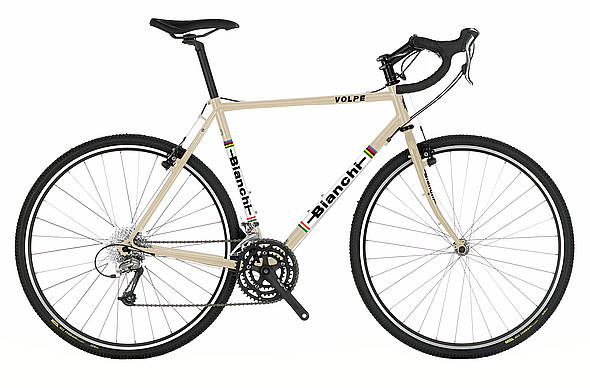
Now let's consider a person looking to do long road rides; perhaps with a local bike club.  Typically, people look to racing bikes with the thought that they need the most efficient machine possible.  However, a marginally heavier bike with capacity for bigger tires will be a bike that is much more comfortable on long rides and likely be better for the motor.  Remember, most roads out there are far from perfect.  Extra volume in the tires create a pneumatic suspension which is very efficient.  If the rider is heavier I would point them to a cyclecross bike such as the Bianchi Volpe.  For a road bike it is considered heavy; but it has all of the ingredients for an excellent all-rounder including much better gearing for ordinary people.  For lighter people who are interested in a road bike who can get away with 28 mm tires with a moderate load, I am sadly too far out of the loop to recommend a model with confidence.  Generally, it is hard to determine how much tire clearance a frame/fork have by just the specifications and I hardly look at new bikes anymore.  But if forced, I'd say look at a Kona Honky Tonk or a Surly Pacer.  Both models appear to deviate somewhat from my concept of a classic all-rounder, but might be appropriate for the right person. 


In large, most people ride little and will make do with what they have and be perfectly fine.  So if your interest is minimal and you just want to ride around the neighborhood a little bit, I would not worry much about the choice.  That is, the extra time you spend worrying about getting the perfect bike could be spent doing something much more productive or fun.  However, if you think that a few extended rides might be your future, a little extra effort in choosing a bike will result in a much better experience. 

P.S.  I wrote nothing about bike fit.  Here is an old post that is essentially a collection of links about bike fit.  A crappy bike that fits well is generally better than a great bike that fits poorly.   A shop will help out a lot in this area. 

Friday, July 1, 2011

My answer ...

This morning a bud pointed me to a question in an article discussing the "20 Craziest Job Interview Questions".
What is the smallest number divisible by 225 that consists of all 1's and 0's?
Despite a heavy workload, I set a mental background processor on the problem.  Quickly, I determined that the answer must be a multiple of 4 for there to be only 1's and 0's.  4 times 225 is 900.  Consequently, the problem revolves around the smallest number divisible by 9 that consists of all 1's and 0's.

Typically, I really stink at these problems.  But my interest was peaked so I created a spreadsheet with multiples of 9 and simply looked for a pattern.  After a couple cups of coffee, deep in the recess of this foggy brain I remembered something about multiples of 9 adding up to 9 or adding up to a multiple of 9.  

So since multiples of 9 must add up to a multiple of 9 and I know that the last two digits must be "00" I guessed "11111111100".  It turns out that 9 * 49382716 = 11111111100.

Needless to say, I would not have gotten the job.