Years and years ago -- pre-children ... hence it seems like forever -- the boss and I became interested in traveling with our bikes. After much thought and research we settled on a pair of custom Bike Friday travel bikes. I have a lot of experience with the bikes: maintenance, club rides, touring, pulling the kiddies, and so on. Given that I get around in the cycling world, I often receive lots of questions about the bikes as well as questions about ordering Bike Fridays. If you're thinking about getting a Bike Friday, then this post is for you.
It rides great. If you're a fast/slow rider on other bikes, you'll be a fast/slow rider on a Bike Friday. For those familiar with
bike geometry, the bike will handle like low-trail bikes that were popular in the past and have a growing set of followers today: the bike will be more and less sensitive to steering inputs at the handlebar and body inputs to the bike, respectively. For those of you who could care less about geometry and simply want to ride, the bike will be a little "squirelly" in the beginning but easily accommodated with a little practice. Handling improves considerably with a front load such that I recommend a handlebar bag or something of the sort instead of a saddle bag. What is the effect of the small wheels? In my experience with a variety of wheel sizes -- 16" through 27" -- the small wheels certainly have some effect but that effect is small relative to other determinants of handling and performance. There are pluses and minuses --
see here for a positive spin on them -- but they definitely make a huge improvement on folding, packing, storage, and general portability.
More about small tires/wheels.
Everyone always asks whether the bike is fast.
Really ... it's not about the bike: it's the motor that is important. Looking back at GPS records of some old 60-mile hilly training rides through Northern Virginia with the Bike Friday and my road bike, it is the case that the road bike was about 5 minutes faster. But my Bike Friday is a 26 pound touring bike whereas the road bike is about 6-7 pounds lighter with a more aggressive position. Without doing any fancy calculations, that difference sounds reasonable and I imagine that if instead one purposely built a Bike Friday for aggressive road riding that most if not all of that 5 minutes would disappear.
Much of what I wrote above depends on how well the bike fits you. In my experience, a well-fitting bike is necessary for "the motor", as well as, for the bike to perform well. If you are more performance oriented and expect to get road bars with the swan stem, I highly recommend getting the Bike Friday fit stem for sizing a custom ultralight or adjustable stem.
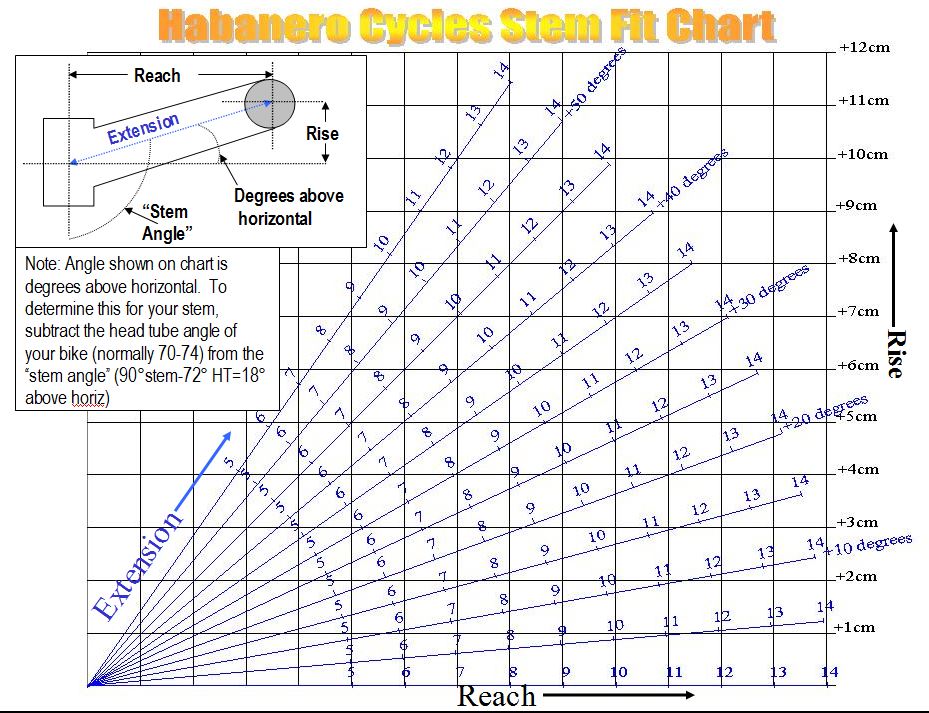
The fit stem allows an incredible amount of adjustment: plus or minus four inches in height and a reach from 50 to 150 mm. I also recommend getting one with a faceplate will let you swap and try out different handlebars on your new bike. A low-trail bike with small wheels is a new experience for a lot of riders. You might find that you want a different amount of weight on the front handlebar or that the relative position of the crank to the saddle results in small changes for the best personal fit. The lack of a top tube might encourage you to use different handlebars with more space for "stuff". I can go on and on; but the point is that I think that you'll discover that having the bike with you will result in a better fit than simply sending your measurements in to Bike Friday. Alternatively, if you plan on using an ahead-type stem, then there is already some sizing flexibility. Remember that Bike Friday can split most aluminum handlebars with a 25.4 or 26.0 mm clamp area. So there is little need to go with the standard bars that Bike Friday offers with their models; although the Bike Friday H-bars and STI-bars are easy to pack and pretty good for recreational riding.
A folding bike for general use and travel is quite useful. In addition to getting the bike into a suitcase, realize that on a lot of trips, you might drive or take a taxi to get from A to B at some point. Since the boss and I can fit both of our bikes into the trunk of a Toyota Echo, just about any ordinary car can take us and our bikes for whatever purpose without a rack. Whenever I do long solo ride, I generally take the Bike Friday since I were ever to bail on the ride or have a big mechanical failure, calling a cab is an easy option. Many public transportation systems have prohibitions against bicycles but
allow folding bikes to be carried onboard.
For most riders, ERTO 406 wheels are a far better choice. For the unfamiliar, it turns out that there is more than one rim/tire size that is labeled 20 inches:
ERTO 406 and 451. Although ERTO 451 has a longer diameter and with some quality tires, most 451 tires are strictly road tires in narrow sizes and is generally unavailable at anything but a bicycle shop that specializes in recumbents and/or folding bikes. Picking a size whose tires and tubes are scarce is probably not the best choice for a travel bike. ERTO 406 is the popular BMX size. Consequently, tires and tubes are widely available -- even at general stores like WalMart and Target -- whereas high quality 406 tires in all widths are available at good bicycle shops or mail order. Note that all of the good 451 tires are available in 406. Long story short, unless one is absolute positive that one is going to stick with narrow road tires and the slightly larger wheel is appealing, I strongly recommend sticking with 406. Since I almost always recommend 406 wheels and typically these bikes are used for travel, I invariably recommend either the New World Tourist or Pocket Crusoe models according to how much the rider weighs.
Generally, I recommend sticking with the standard derailer drivetrain. Moreover, getting low gears are not a problem with a Bike Friday. Instead, determining how high of a gear you need is the problem. I'm assuming that you have already read this
summary by Green Gear Cycling and that you have some cycling experience. The vast majority of people choose between a
standard derailer drivertrain or the
SRAM Dual Drive since internal hubs with wide gear ranges are much more expensive. Before we begin discussing the choice,
we need to understand that the 20" wheels directly leads to a drivetrain with lots of low gears -- gears where it is easy to spin the crank but not move fast. But even recreational hybrids bicycles will still have top gears around 100+
gear inches. Just based on personal observations, few people ever use those high gears with any frequency whereas having a low gear, particularly for touring, is quite helpful for long climbs.
The SRAM Dual Drive has several advantages/disadvantages relative to the derailer drivetrain:
- No front derailer that can be damaged ... this is particularly good for folding the bike.
- Lowering or raising the gear range is very easy ... just change the chainring.
- A wide cassette leads to a very wide drivetrain; i.e., lots of low and high gears.
- Three speed internal hubs are a very mature technology and very robust. Although there are anecdotes to the contrary. For instance, there are a few discussions on bentrideronline.com where people tell stories of their failures in various situations. But my take is that three speed hubs have been around forever in a wide variety of uses.
- Internal hub can shift at a standstill.
- Annoying "clickbox" is at an exposed part of the bike: outside the rear derailer.
- Parts can be hard to obtain.
The derailer drivetrain has several advantages over the SRAM Dual Drive:
- It is the standard for bicycles and consequently much easier to repair.
- It is about 1 to 1.5 pounds lighter.
- A maintained derailer drivetrain shifts faster and crisper.
- Supposedly the derailer drivetrain is more efficient; although other than some articles in the Journal of Human Power -- see issues 50 and 51 -- I see little evidence for the statement. But my personal anecdote says that it is true and a lot of high-level technical people seem to believe it.
- Despite being subject to damage from travel and being dropped, derailers are still quite robust in my experience.
- Relative to the SRAM Dual Drive, there are much cheaper derailer options available.
My take on all of this is to go with a derailer drivetrain. One,
weight does matter with a folding/travel bike. Sometimes you might carry the bike a long distance -- say you fold the bike and carry it through a train station. When you travel with the bike it is my experience that airlines roughly check luggage size whereas they carefully check its weight. Two, by my tastes, efficiency matters on anything other than short rides and keeping a well-maintained system is second nature to me. Lastly, in the case of a travel bike, standard components that are easily and cheaply fixed are preferred to a system that is more robust but a complete disaster when broken. With a derailer drivetrain, good advice and service is very easy to acquire.
The best derailer drivetrain will depend on the top gear you want. Pick a Shimano Capreo hub/cassette if you want a top gear over 100 gear inches or wish to use index shifting; otherwise stick with a standard hub/cassette. Essentially, the Capreo cassette will let a rider stick with a standard Shimano crank/chainring combination -- or presumably Campagnolo or SRAM -- that will shift really ... really well and be better for packing in a suitcase: a big chainring will get very close to the edges of a suitcase which makes it more likely to get damaged in transit. Of course, going with the Capreo cassette/hub means you are getting something "special" that will be hard to acquire from anyone other than Bike Friday or the Harris Cyclery in a pinch: For a price you can get anything delivered FedEx! To some extent you have some of the same problems as the SRAM Dual Drive. But there is an important difference, the Capreo hub/cassette works the same way as other hubs/cassettes such that a competent mechanic will know what to do and how to fix the problem. From what I observe, Capreo components are actually carried by a few online retailers; but Bike Friday and the Harris Cyclery are the two that I use. The alternative which I strongly recommend if you're comfortable with bar ends and would be happy with a top end around 95 gear inches -- I believe that most people have gearing that is way too high -- then you can get a decent gear range with marginally larger than normal chainrings.
Here I propose a chainring/cassette combination with a normal cassette and compare it to a standard Capreo cassette.
The one case where I would pick the SRAM Dual Drive is if one were going to fold the bike often and in somewhat of a hurry. On 20" wheel Bike Fridays, the folding rear triangle is independent of the front derailer mount. Moreover, the distance between the rear axle and front derailer gets shorter as the bike is folded. Consequently, the chain will flop around a bit, fall off, and, if one is somewhat careless, the chain will hang on the front derailer such that spinning the rear wheel will put a lot of force on the front derailer.
Check out
Bike Friday's Youtube videos for more information on the folding process.
The fold with a single chainring.
The fold with multiple chainrings. Now that you have seen the single chainring video, note that you can install Bike Friday's
chain retainer to avoid chain drop issues during folds. Note that if you intend on folding/unfolding the bike a lot and in somewhat of a hurry, you might consider
the folding stem.
Of course, if you want a bike that will be folded a lot and in somewhat of a hurry, the Bike Friday tikit or Brompton might be a better fit for you. But I can imagine some scenarios where one would prefer the bigger and more robust bike that still folds easily.
Get a high-end head set for the Bike Friday. In the past, Bike Friday offered the Chris King headset which by no means is cheap. But considering the extra forces on the headset -- the super long stem mast is a giant lever -- I think it is worth every penny spent. Recently I noticed them carrying the Cane Creek 110 which has a 110-year "no questions asked" warranty. I have no experience with it, but I suspect that it is pretty good too.
Use rims drilled for schraeder-valves and use adapters for presta-valve tubes. Personally, I think presta valve tubes are superior to shraeder valve tubes. But it is the case that most ERTO 406 tubes at common stores will be schraeder. If you're traveling and desperate for a tube, being able to remove the
adapter is a great option at a trivial weight cost.
Small wheels are wildly strong. Don't be afraid to use lower spoke counts than you would on a typical touring bike. Just because of hub and rim availability -- especially at lower prices -- one is likely limited to 32 spoke holes. But Bike Friday will often lace
36-hole hubs to 24-hole rims as a cost effective method for low-spoke count wheels.
Wide, high-quality tires are strongly recommended. Ignoring my conclusion that
wider tires are more efficient than most people commonly believe ...
- Wide tires can be efficiently ridden at much lower pressures. Consequently, it helps alleviate the additional bumpiness from small wheels.
- Wide tires will also help slow down the steering up front.
Of course they will be heavier, but at least this are small diameter tires and will be less heavy than typical wide tires. Personally speaking, I think life is too short to get crappy tires and most wide tires are low end. But thankfully, there is a good selection of high quality high end tires in ERTO 406. Folding tires are also good for travel bike since they pack better and are somewhat lighter.
Carrying loads on the front wheel is recommended. As I mentioned earlier, since the trail is so low on Bike Friday's, carrying loads on the front wheel helps slow down and
improve the steering. Moreover, the front wheel is almost always stronger than the rear wheel. A handlebar bag also gives the rider easier access to "stuff" while riding.
Will you ever fold the bike? If no, strongly consider the Easy Pack Mast. The Easy Pack Mast is not hinged from the frame. As the name implies, it makes it easier to pack into a suitcase. It is also somewhat lighter than the typical folding mast. If you have money to burn or want something even lighter, get the titanium upgrade for the easy pack mast.
Believe it or not, that is about all that I typically recommend in a generic sense on a new (or used) Bike Friday either because I find it hard to broadly support a choice or I have little personal experience with it. Some of the things I barely discuss are the Bike Friday tikit, fenders, suspension, and using racks versus the suitcase/trailer (you can find the Bike Friday description on their
FAQ page and a
negative review here). I always recommend joining the
Bike Friday YAK and talking to others in a
local Bike Friday club; if you are in the DC area,
you can find us here. Generally, you will find lots of helpful folks more than willing to share their experiences and advice. Shockingly people will disagree with my assessments, but it would be worthwhile for a potential buyer to read/hear alternative reasoning.
 |
| Say hello if you see us. |